NASA Administrator Jim Bridenstine was cautious about commenting, coining the explosion an "anomaly" in a tweet released after the blast occurred. He said: ”This is why we test. We will learn, make the necessary adjustments and safely move forward with our Commercial Crew Program."
The unconfirmed video, shared on Twitter and since deleted, appeared on Sunday and showed a severe explosion in the spacecraft.
But, the recent set back has not affected NASA’s plans to launch a cargo version of a SpaceX Dragon spacecraft to the International Space Station next week.
During a previously scheduled media teleconference on April 22 about the upcoming NASA launch of the Dragon capsule to the International Space station, NASA spokesman Josh Finch announced that the cargo delivery mission using Space X’s Dragon Capsule would still go ahead.
The explosion, at SpaceX’s Landing Zone 1, produced a large cloud visible for miles and reportedly caused major damage to the Crew Dragon spacecraft.
This was the same capsule that flew on a test flight to the ISS in March.
The crewed test flight will still happen, but due to investigations after the explosion, it will be delayed by several months.
Investigators need to be certain of the cause of the accident, and steps to remedy the problem.
Luckily, one was aboard the craft during the test.
SpaceX isn't the only company working to build a viable spacecraft for crewed missions.
Boeing is due to launch its Starliner capsule uncrewed later this year.
However Boeing's launch has faced its own delays.
Until one of these companies gets its crewed rockets working, NASA is stuck hitching rides for its astronauts to and from space on Russian Soyuz capsules.
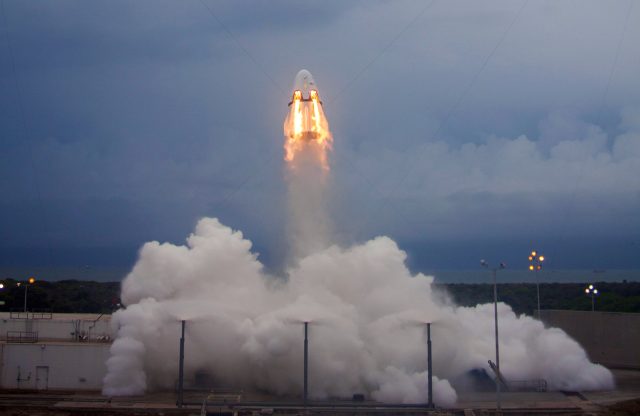
SpaceX's Crew Dragon Spacecraft completed a pad abort test in May, 2015. This image shows the vehicle's eight SuperDraco thrusters firing as intended.
SpaceX
During a series of engine tests of SpaceX's Dragon spacecraft this past Saturday, the vehicle experienced what the company has characterized as an "anomaly." Based upon an unauthorized leaked video of the accident, the company was counting down toward a firing of the Dragon's SuperDraco thrusters when the vehicle exploded. SpaceX has not validated the video, but it is consistent with verbal accounts of the failure that have been shared with Ars.
After the accident, large dramatic clouds of orange smoke billowed above "Landing Zone 1," where SpaceX conducted Saturday's engine tests. According to one source, the orange plumes were the result of between one and two tons of nitrogen tetroxide—the oxidizer used by Dragon's SuperDraco engines—burning at the location. After a dramatic weekend, what follows is a summary of what we know, what we don't know, and where SpaceX goes from here.
What was destroyed?
The Crew Dragon capsule in question is the same one that successfully flew a demonstration mission to the International Space Station in March. The spacecraft was being prepared for a launch abort test this summer. During this test, the Dragon would have launched from Florida on a Falcon 9 booster and then fired its powerful SuperDraco engines to show that the Dragon could pull itself safely away from the rocket in case of a problem with the booster before or during flight.
Now that SpaceX has lost this capsule, it must find a substitute for this launch abort test. It is not clear whether it will fabricate a boilerplate vehicle with a SuperDraco system of eight thrusters, or re-purpose one of the Dragons it has built for crewed flights to the space station. Either way, this is a significant materiel loss for the company.
How did it happen?
We don't know. According to the leaked video, the anomaly occurred within the final 10 seconds of the countdown, and it is not entirely clear whether the SuperDraco engines had begun to fire. One source indicated that the company has a lot data about the failure—this was a ground-based test, so the vehicle was heavily instrumented—so theoretically finding the root cause of the accident should be more straightforward than had a problem occurred during a real flight. The best case scenario, in terms of causing delays for SpaceX, would be that someone mishandled the ground systems equipment. The worst-case scenario is that there is some undiscovered but fundamental design problem in SuperDraco thrusters.
During past accidents, SpaceX founder Elon Musk has been fairly forthcoming about the cause of the failures, and we hope for similar transparency with this accident. I would argue that, since this vehicle will eventually carry humans and is funded largely by NASA, transparency is essential to ensuring public confidence in the vehicle and company's processes.
Was anyone hurt?
Thankfully no. The last time we saw this dramatic of a ground-based spacecraft failure was during the Apollo 1 fire in 1967, which cost three human lives. Fortunately, no one was harmed during Saturday's accident, which speaks well of SpaceX's safety practices during such dynamic tests. Had humans been injured or killed, it would have undoubtedly complicated the already complex road ahead for SpaceX.
What does this mean for commercial crew flights?
NASA provided multibillion dollar contracts to SpaceX and Boeing in 2014, with the intent of bringing their Dragon and Starliner vehicles into service for getting U.S. astronauts to the space station. Before this accident, SpaceX and NASA had been targeting early October for the first crewed Dragon mission to the station. Now, that will almost certainly be delayed by at least several months, into 2020. Before Saturday, Boeing's Starliner spacecraft was behind Dragon in terms of development, and is also unlikely to fly humans before early 2020.
NASA recently signed a deal with Russia to purchase two additional Soyuz seats, for one crew member each, which will ensure a U.S. crew presence on the station through September 2020. The agency may well now be forced to return to the Russians yet again to procure more seats through the end of 2020.
What does SpaceX do now?
Undoubtedly, the company had a busy Easter weekend. The first step is determining what happened, and then working with NASA to fully understand the problem, and then to devise a fix to ensure the problem never happens again. Internally, the company's engineers may already know what occurred.
I would also be hugging NASA were I in SpaceX management—leaning on the agency for its expertise in human spaceflight systems as well as seeking cover from political fire. After a Falcon 9 rocket launch failure in 2015, in which the CRS-7 supply mission to the International Space Station was lost, the agency stood by its commercial cargo partner. NASA human spaceflight chief William Gerstenmaier offered public support for the company, beat back Congressional doubters, and helped SpaceX get back to flying quickly.
In recent years, some NASA critics have viewed the agency as "holding back" SpaceX during the development of the Crew Dragon vehicle with unnecessary paperwork and requirements. This may be partly true, but NASA is the customer, and clearly there are hazards yet to be found in the Dragon (and probably Starliner, too). The fact is that NASA needs SpaceX to succeed, and so the company and the space agency are presently in a position where it's best for everyone if they work together side-by-side, identify and fix the issue, and move on.
There is a precedent for this. After the Apollo 1 fire revealed multiple problems with the first version of the spacecraft, NASA worked closely with the Apollo capsule's contractor, North America Aviation (now a part of Boeing) to accelerate design a much safer updated capsule design. The fire occurred in January 1967, and the updated "Block II" Apollo capsule made its first spaceflight less than 21 months later. The design would go on to fly a historic succession of lunar missions.
Don't discount SpaceX
it would be easy to write off SpaceX as a reckless company. But the reality is that this is a company moving rapidly in a lot of different directions—building the world's largest operational rocket (Falcon Heavy), perfecting first stage re-use, launching more rockets than any other company, trying to recover payload fairings, and building an unprecedented, next-generation vehicle called Starship.
This accident should offer a clarifying moment for SpaceX and Musk, that it really must get commercial crew right—and that putting humans on a Falcon 9 rocket, inside a Dragon spacecraft, raises the stakes. This is not easy. It is very hard.
There should be little doubt the company can come back from this. SpaceX has shown a propensity for responding to failures with speed and an ability to fix problems. After the CRS-7 failure in 2015, they were flying again six months later. Remarkably, the return to flight mission also was the first successful Falcon 9 landing.
After the Amos-6 launch pad failure in 2016, the company was flying again 4.5 months later, and has had its most successful run since then. The company can get beyond this accident, but now that humans are involved it will require focus, transparency, and closely working with NASA to move on.
By Benjamin Raven | braven@mlive.com | Posted April 22, 2019 at 08:30 AM
The annual Lyrid meteor showers are expected to peak Monday night, April 22 into Tuesday morning, and this post will run through everything you need to know to catch those fireballs in the sky. NASA says the Lyrids have been observed for 2,700 years dating all the way back to ancient China in 687 BC.
"The Lyrids are known for their fast and bright meteors, though not as fast or as plentiful as the famous Perseids in August, Lyrids can surprise watchers with as many as 100 meteors seen per hour," the U.S. space agency says of them.
"Lyrids frequently leave glowing dust trains behind them as they streak through the Earth's atmosphere. These trains can be observable for several seconds."
By: Benjamin Raven | braven@mlive.com
As this year's Lyrid meteor shower peaks Tuesday morning, we could be treated to as many as 20 fireballs per hour in the sky.
Unfortunately for those of us in Michigan, we are listed in the poor to fair visibility during the prime days of Lyrid watching between Sunday and Tuesday. This comes after back-to-back years of great visibility for the annual showers in most parts of the Great Lakes State.
For those wondering how to watch the action, NASA notes that no special equipment is required.
"Simply find a dark, open sky away from artificial lights," the U.S. space agency writes on its website.
"Lie down comfortably on a blanket or lawn chair, and look straight up."
Yesterday we talked a bit about a serious failure of the SpaceX Crew Dragon capsule during testing. The capsule suffered an explosion and spewed orange-colored smoke at Cape Canaveral where the capsule was being tested. NASA said of the explosion “This is why we Test.”
Video footage of the explosion or “anomaly” as SpaceX refers to it has surfaced. The video is extremely grainy and appears to possibly have been shot on a mobile phone. The quality of the video is poor enough that we can’t tell what happened.
One second the capsule is there, and the next second it’s gone with smoking chunks of debris left lying on the ground. Early reports indicate that the failure of the capsule happened when SpaceX was testing the SuperDracos engines.
The engines are said to be in armored capsules that are supposed to prevent catastrophic loss of the vehicle if one engine fails or explodes. SpaceX has stated that it is investigating the accident at this time. As of now, nothing has been said about the accident. SpaceX CEO Elon Musk hasn’t tweeted about the issue or giving any insight, something he usually is quick to do.
Speculation suggests that the explosion during testing could push SpaceX’s manned launch back to next year, but that is unconfirmed at this time. The first crewed launch for the Crew Dragon capsule was set for July. NASA stated in a tweet that its commercial crew program would continue. For the foreseeable future, it appears that U.S. astronauts will have to continue hitching rides with Russia to get to the ISS.
Archaeologists have uncovered a 350-year-old massacre in Alaska that occurred during a war that may have started over a dart game. The discovery reveals the ...
Climate change is real and increasingly a part of our daily lives. New research and studies out in just the past six months highlight the latest facts about the human-caused shift to our global weather systems and its effects on our planet. There's no longer any question that rising temperatures and increasingly chaotic weather are the work of humanity. There's a 99.9999% chance that humans are the cause of global warming, a February study reported. That means we've reached the "gold standard" for certainty, a statistical measure typically used in particle physics.
• 10 amazing places where travelers can see a changing climate
Armed civilians detained migrants at the border
A New Mexico man whose group of armed volunteer border patrollers detained undocumented immigrants is slated to appear in court Monday following his arrest. The FBI arrested Larry Mitchell Hopkins, 69, Saturday on charges of being a felon in possession of a firearm and ammo. He is expected to appear Monday in the U.S. District Court in Las Cruces. Hopkins previously identified himself as the national commander of the United Constitutional Patriots, a group that drew the ire of the American Civil Liberties Union and New Mexico Attorney General Hector Balderas after it began detaining migrants they encounter who crossed into U.S. territory.
Got an old car seat? Get a coupon.
Target's popular car seat trade-in event returns Monday. From April 22 through May 4, Target stores will accept and recycle car seats, including infant seats, convertible seats, car seat bases, harness or booster car seats. In exchange for the old car seat, customers get a coupon for 20% off select baby gear. Since Target introduced its first car seat trade-in program in April 2016, half a million car seats and more than 7.4 million pounds of materials have been recycled. Nowhere near a Target but want to help the planet? A website dedicated to recycling car seats has state-by-state options.
He weaponized an iguana
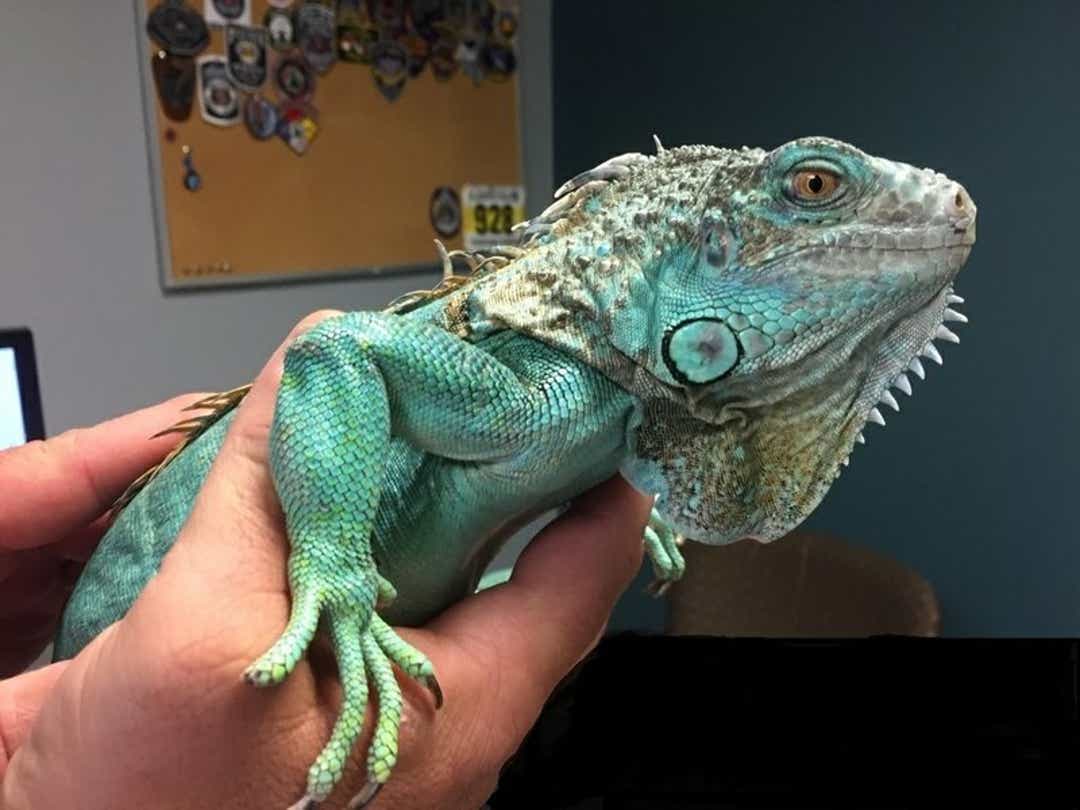
A man in Ohio tried to weaponize a live iguana when he spun the lizard above his head and flung it at a restaurant manager, breaking the reptile's leg, police say. Arnold Teeter, 49, was charged with disorderly conduct, resisting arrest and cruelty to animals in connection with the Tuesday incident at a Painesville, Ohio, restaurant, the city's police department said. "Upon handcuffing, officers located an approximately 2 foot iguana from under his sweatshirt," the department said. It wasn't immediately clear if Teeter had an attorney and his next court date was set for Monday.
Look up for they Lyrid meteor shower
The Lyrid meteor shower is coming to a sky near you, though a bright moon may interfere with your sky watching. Experts say the peak will come early Monday morning or Monday night into Tuesday morning. The meteor shower sometimes bombards the sky with up to nearly 100 meteors per hour, which are known as outbursts. The Lyrids appear each year from about April 16 to 25, according to Earthsky.org. NASA said they have been observed for more than 2,700 years, making them one of the oldest known showers.
While we can't see dark matter, it's thought to make up a large part of our universe's mass.Gemini Image Gallery
When researchers at Yale University claimed to have discovered a galaxy containing no dark matter in March 2018, their work was met with a mixture of praise and criticism.
Much of the criticism the discovery received was down to the fact that it completely contradicts existing dark matter theory.
However, scientists recently made an exciting discovery — they found yet another galaxy that appears to contain only "normal" matter.
When researchers at Yale University presented the results for their observations of galaxy NGC1052-DF2 in March 2018, their work was met with a mixture of praise and criticism.
Their research suggested that the unusual galaxy contained little to no dark matter — the idea contradicts existing dark matter theory, which is part of the reason why it drew so much attention.
However, a team led by Sol Goldman Family Professor of Astronomy at Yale University, Pieter van Dokkum, has discovered yet another galaxy that doesn't contain any dark matter — a discovery that supports their initial observations that dark matter is actually separable from galaxies.
These findings may require us to totally rethink previously held assumptions about how galaxies are formed.
While we can't see dark matter, it's thought to make up a large part of our universe's mass. Our galaxies consist of dark matter as well as "normal" matter like stars and planets, for example.
The scientists' discovery of galaxies that contain little to no dark matter is unprecedented and came to them as somewhat of a surprise.
"The fact that we're seeing something that's just completely new is what's so fascinating," said Shany Danieli in Keck Observatory, who first spotted the galaxies two years ago. "No one knew that such galaxies existed, and the best thing in the world for an astronomy student is to discover an object, whether it's a planet, a star, or a galaxy, that no one knew about or even thought about."
In order to take a closer look at the discovered galaxies, the research team followed the movements of ten star clusters, allowing them to ascertain how much mass was in each galaxy.
Unusually, they found the galaxies contained only as much mass as the stars would normally have had, meaning that — most likely — there was probably only normal matter present in the galaxy.
The second galaxy found to be absent of dark matter has been dubbed NGC 1052-DF4 — a discovery that's just as exciting for the researchers as the original discovery of DF2.
"This means the chances of finding more of these galaxies are now higher than we previously thought. Since we have no good ideas for how these galaxies were formed, I hope these discoveries will encourage more scientists to work on this puzzle," Dokkum told the Keck Observatory.
Up until recently, it was thought that galaxies couldn't form without dark matter — but Rita Wechsler of Stanford University said to National Geographic, "We need to rethink what a galaxy is."
Both DF2 and DF4 belong to a relatively new class of galaxies called ultra-diffuse galaxies. According to Keck Observatory, they're roughly the same size as the Milky Way but have far fewer stars, which causes them to appear "fluffy" and "translucent", making them harder to observe.
Despite the lack of dark matter in these galaxies, their existence actually further bolsters the dark matter theory: it backs up the idea that dark matter is a substance not coupled to "normal" matter, and shows they can both be found independent of one another.
The researchers highlighted their hope to continue exploring new galaxies, saying: "Our hope is that this will take us one step further in understanding one of the biggest mysteries in our universe – the nature of dark matter."
Den Originalartikel gibt es auf Business Insider Deutschland. This post originally appeared on Business Insider Deutschland and has been translated from German. Copyright 2019. Und ihr könnt Business Insider Deutschland auf Twitter folgen.